Showing posts with label Unit 3 Water. Show all posts

Friday, 22 November 2019

Vocabulary Unit 3


  • Water Cycle : It is the process when the water changes its physical state.
  • Fresh water : It is the water found in rivers, lakes, glaciers, groundwater and at the poles.
  • Groundwater : It is the water run and is scored under the ground.
  • Flow : It is the amount of water it carries
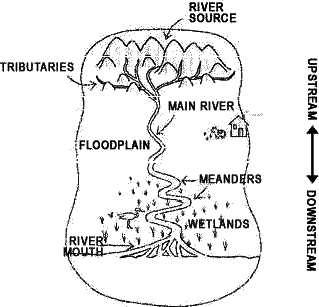
  • Basin : It is the area occupied by a river and its tributaries.
  • Tributaries : It is smaller rivers flowing into a large river.
  • Source : It is the place of a river starts.
  • Glaciers : They are masses of ice created by the accumulation of snow.
  • Lakes : They are permanent masses of water which have accumulated inland.
  • Wadis : They are basins in the desert.
  • Rivers : They are permanent currents of water
  • Canals : It is build by human beings, and used to transport water.
  • Reservoirs : They are artificial lakes to store water.
  • Water supply : It is the water in reservoirs and is offered to people and industries.
  • Dams : They are build of human beings used to produce electricity.
  • Hydroelectric power station : It is a station used to produced electricity through the water.
  • Salinity : It is the amount of salt with containing the oceans and seas.
  • Warm current : These currents are produced when the temperature of a current is higher than the water around it.
  • Cold current : These currents are produced when the temperature of a current is colder than the water around it.
  • Tides : They are the diary rise and fall of the water level. They are caused by the gravitational forces of the Moon and the Sun.
  • Waves : They are undulations of the surface of the water produced by wind.
  • High tide : This tide is produced when rise the level of sea.
  • Low tide : This tide is produced when falls the level of sea.
  • Lagoons : It is smaller lakes.
  • Inland seas : It is a saltwater lake.
  • Ocean currents : They are large masses of water, similar to rivers, which circulate through oceans.
  • Aquifers : It is forms when the water can´t pass through the impermeable rocks
  • Springs : It is forms when groundwater finds a way to the surface. They can be cold or hold water.
  • Drinking water : It is the water you can drink. Groundwater is valuable because there are drinking water.
  • Icebergs : It is a floating mass of ice.
  • Consumption : It is the fresh water which use the human being for life. It is only 0.014%.
  • Droughts : It is shortage of water.
  • Floods : It is excess of water
  • Water Pollution : It is large amount of materials are added to a body of water.
  • Acid rain: It contains harmful chemicals such as sulfur and nitrogen. These chemicals are released into the atmosphere as gases.

Tuesday, 5 November 2019

How do glaciers shape the landscape?

Investigating about the ocean

With this page and your book, we are going to investigate about the ocean.


You have to do these activities:

  1. Why is the ocean salty
  2. What causes Waves?
  3. What causes Tides?
  4. What is a Tsunami?
  5. What are Deepest depth?

Monday, 28 October 2019

The course of a river

  • Explain the difference between the upper course, middle course and lower course of a river.
  •  Where is the place to erosión? , and to the deposition of sediments?
  • What types of reliefs are possible in these areas? Look  for information here and in your book, page 42
 
Complete the table:
 

Course of a river
Parts Where? Main features
Upper


Middle


Lower


Link to investigate

Rivers

Link to: How Rivers and Streams Affect the Earth's Surface

Vocabulary Unit 3. Water

Unit


  • Water Cycle
  • Fresh water
  • Groundwater
  • Flow
  • Basin
  • Tributary
  • Source
  • Glacier
  • Lake
  • River
  • Canal
  • Reservoir
  • Dam
  • Hidroelectric power station
  • Salinity
  • Warm current
  • Cold current
  • Tide
  • Wave
  • High tide
  • Low tide
  • Lagoon
  • Inland sea
  • Ocean current
  • Aquifer
  • Spring
  • Drinking water
  • Iceberg
  • Drought
  • Flood
  • Water Pollution
  • Acid rain
  • Homework:
    • You have to look for the meaning of these words and write them in english;
    You need to know these words and your meanings for the next exam. I´m going to ask you.

    Sunday, 27 October 2019

    Sunday, 18 December 2016

    Investigation work: Rivers in Castilla y León

    We Investigate about the main rivers in our region.

    Every  group have 2 people. The work have  these points:

    • Main  rivers in our region (Castilla and leon), with a  river map.
    • Especially the features os the rivers Tera, Esla and Orbigo, features as  sources, basins, flows,  reservoirs ...
    • Especially the differences from winter to summer in their flows.    
    • How  is the way that  we take the water supply for  Benavente?
    • How is the landscape next to the rivers? Type of vegetation.
    • Explain why water pollution  is such a serius problem in the world.
    • Examine two o three especific problems in our rivers: Esla, Tera and Orbigo.
    • Argue what we can all do about it.
    Task: Write an essay  with all the information, with pictures.