
Showing posts with label Unit 9.Early civilizations. Show all posts

Tuesday, 16 June 2020

Quizizz ancient Mesopotamia and Egypt

or
Pide a participantes que abran
joinmyquiz.com
e introduzcan este código
7978629

Tuesday, 2 June 2020

The Egyptian myth of Isis and the seven scorpions

Art in Egypt

After watching the videos, using your book  on pages 154 and 155, and others materials, make a presentation about the Egyptian religion   and art.


Monday, 1 June 2020

Great Pyramid of Giza

The Egyptian Book of the Dead: A guidebook for the underworld

Let’s Begin… 
Ancient Egyptians believed that in order to become immortal after death, a spirit must first pass through the underworld — a realm of vast caverns, lakes of fire, and magical gates. Needless to say, one needed to come prepared. But how? Tejal Gala describes an Egyptian "Book of the Dead" -- a customized magic scroll written by the living to promote a smooth passage to the afterlife when they died.
.
Explain:
  • What is the Book of the Dead for?
  • What must the dead pass before they can reach the afterlife?
  • How will the dead be in the afterlife?

How to make a mummy


.

Mummification was done to preserve the body because the soul and the ka meet and live again. The practice started in the pre dynastic period with the change from simple desert burials, which preserved the body naturally, to burial in coffins. Although the coffins protected the bodies from the attacks of animals they encouraged decomposition. Then the Egyptians developed a technique to maintain the bodies. The essential steps in mummification were removing the viscera, dehydrating the body with natron, treating it with resin, wrapping them in strips of linen, or bandages, and finally decorating it. The ceremonial aspects were considered crucial, and the procedure took about seventy days. Today we call this process mummification

TASK:

• What was the purpose of natron?

• About how many days did the process of natron take?

• Why do you think they preserved some organs?

• Why was the brain discarded?

• What did they wrap the body with?

• How did Egyptians mourn the dead?

• What was mummification for? Highlight the correct answer.

a) For the after life. Egyptians believed in a second life.

b) Because they liked it.

c) Because they wanted to preserve the body.

What was natron for?

a) For cooking. It is very useful.

b) Mineral salts, very useful for mummification.

c) To throw it into the water.

What was ka?

a) Ka was a fly.

b) Ka was the spiritual part of the body.

c) Ka was the soul of the Pharaoh

• Now describe the process of mummification. There are five main steps.

a) First of all they removed the viscera.

b)

c)

d)

• How long did all the process take?

• What kind of burial do you think the farmers had?


• Link the sentences from the column A to column B A B

1 How many days was the body covered with salt?              a-The heart.

2 Which organ was not removed?                                         b-A salt used to dry the body.

3 What bandages did the Egyptians use?                             c-Palm wine.

4 What is natron?                                                                  d-The mummy organs’ jars.

5 What were the canopic jars?                                              e-Linen strips.

6 What wine was used to clean the body?                            f-35/40 days

• Which step to step comes in the sequence before to burial?

a. The body is placed in a coffin.

b. The body is wrapped in linen bandages.

c. The coffin is placed in a tomb.

d. Organs are removed from the body
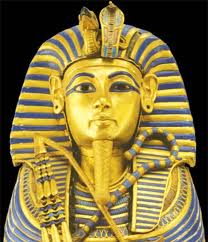

Let’s know more about egyptians

Sunday, 31 May 2020

The pharaon that wouldn´t be forgotten

.

Look for information about Hatshepsut: It necessary to discover five news of this female pharaoh

Friday, 29 May 2020

King Tut Was Murdered

King Tut Was Murdered
By Kevin Meyer

King Tutankhamen�s death is mysterious and the cause of death has not yet been figured out. To some, it was a fatal accident, to others it was an unforgettable murder. Surely it was murder, because of damage and a blood clot found in his skull, but who murdered him is the puzzling question. Anybody that had contact with the king could be accused or at least questioned.
King Tut became king when he was approximately 8-9 years old. Evidence suggests that he was around 18- 19 years old when he died. This is, obviously, a young age to die. Howard Carter, an archaeologist who discovered King Tut�s tomb in 1922, also discovered his mummy. Current technology such as x-rays shows a huge bump on his head and bone fragments in his skull. Because of the physical evidence, the huge bump on his head and with the blood clot found there, King Tut was definitely murdered.

Two minor suspects are the cupbearer and the king�s attendant. They are likely to be among the few that could approach the king without orders and or go into his bedroom when he was asleep. They surely had access and permission to go about in Tut�s room without permission.

After Tut�s death, Ankhespaton, King Tut�s wife, sent away for a prince of the Hittites (Egypt�s enemies) that wasn�t part of the kingdom so that she didn�t have to marry Aye and she could still stay queen. The Hittite prince was murdered on the way to Egypt before he could marry Ankhespaton! Later Queen Ankhespaton mysteriously disappeared after finally marrying Aye the vizier for King Tut!

Another possible suspect could be General Horemheb. He was the powerful army officer that eventually ascended to Tut�s throne. Horemheb was trusted by King Tut. It has already been stated that the Hittite prince on the way over to Egypt to marry Ankhespaton was murdered. Guess who sent orders to have him killed? Horemheb. He was the head of the military and he ordered soldiers to kill the prince. As an army official, Horemheb would be dishonest to investigators in order to keep his job. He wanted the prince dead so that Ankhespaton would have no choice; she would have to marry Aye. Later Horemheb did his best and succeeded in erasing Ankhespaton, Aye, and King Tutankhamen from the Royal Book of Kings and Queens.

The last and most reasonable person who would want Tutankhamen dead would be Tut�s grandfather and also the vizier of Tut, Aye. He was very jealous that Tut became king when he was only eight or nine years old. A lot of evidence shows that Aye is a very reasonable suspect of killing Tutankhamen. After Tut�s death, Aye refused to start an investigation. He didn�t bother to research the dramatic story about Tut�s death and he advised other people not to either. Since people don�t know who murdered Tut Aye and Horemheb most likely were working together.

King Tut was murdered by one of these people. It was a very unfortunate death. The dramatic research is still going on. Remember, King Tut died from something other than natural causes, his mummy shows it.
 .
TASK: You have to read the text and watch the videos.  Then, answer these questions:
  1. King Tuts nickname:
  2. Age when he became pharaoh:
  3. Age when he died:
  4. Fathers name:
  5. Wifes name:
  6. Who discovered his tomb:
  7. Location of tomb:
  8. Interesting fact about his reign:
  9. Something found in his tomb:
  10. How long he reigned:
Send me the task.


Tuesday, 26 May 2020

Vocabulary unit 9

Writing: It appeared in Mesopotamia over 5,000 years ago.

River civilizations: It is the civilization developed along large rivers surrounded by fertile land. The main rivers are the Tigris , Euphrates, Nile ...

Civil servant: People who work as scribes, could read write and count . They write the laws and the commercial transactions.

Hierarchical society: It was when the society was divided into clearly differentiated groups.

Cuneiform writing: It is a type of writing, consisted of signs drawn on clay tablets with a reed.

Hammurabi: It was the person who wrote the earliest law code.

Sumerian period: It was a country that were dominant in the third millenium BC. Independent cities were ruled by high priests in this period. It was the first mesopotamia civilizations.

Slaves: it is the part of the population they had no rights. Usually are prisoner of the war.

Ziggurats: They were the temples in the Mesopotamian region. They were built as stepped pyramids. They were built with mud.

Floods and dams: It is necessary when the water grow up.The wall to border the river and to control the water is a dam.

Mummy: It's a dead body. They were preserved in Egypt

Hieroglyphics: It is a type of writing, consisted of signs engraved on Egypt. They were created around 5,000 years ago. Some hieroglyphics signs represent an idea while others represents a sound.

Pharaohs: They were the egyptian Kings

Papyrus: It is a kind of paper used by the egyptians to write.

Old kingdom: It was a period in the Egypt History,

Middle kingdom: It was a period in the Egypt History,

New kingdom: It was a period in the Egypt History, started around 1600 BC.

Thebes: It was the capital in the Middle and New Kingdoms.

Memphis: It was the capital in the Old Kingdom, with pyramids

Polytheistic: It is when in a religion, the people believe  a lots of gods

Afterlife: It is when in a religion, the people believe in a life after dead

Pyramid: It's a tomb, the place where the pharaoh was buried.

Hypogeum: It is a type of egyptian tomb, built in the rock

Mastaba:  It is a type of egiptian tomb

Monday, 25 May 2020

A day in the life of the ancient Egipt doctor

Read the text in your book  on pages 152 and 153
Make the activities 1,2, and 4
After that, watch this video 
At the end of the video explain:
  • How is the medicine in Egypt?
  • How is the ordinary  life in Egypt?
  • What is most relevant in your opinion about the video?

Tuesday, 19 May 2020

Vocabulary. Unit 9


Homework:
  • You have to look for the meaning of these words and write them in english;
You need to know these words and your meanings for the  exam. I´m going to ask you.
Writing
Pharaohs
River civilizations
Papyrus
Civil servant
Old kingdom
Hierarchical society
Middle kingdom
Cuneiform writing
New kingdom
Hammmurabi
Thebes
Sumerian period
Menphis
slaves
Polytheistic
ziggurats
Afterlife
Flooded and dams
Pyramids
Mummy
Sarcophagus
Hieroglyphics
scribe

Sunday, 17 May 2020

Ancient Egypt | National Geographic


Geography of Egypt


1. What is today the capital of Egypt? _______________________
2. What sea borders Egypt to the north? _______________________
3. What is the name of the canal that divides mainland Egypt from the Sinai Peninsula? _______________________
4. What is the name of the major river that flows through Egypt? _______________________
5. What is the name of the desert that borders Egypt to the west? _______________________
6. What is the name of the country that borders Egypt to the south? _______________________
7. The Aswan Dam is at one end of which lake? _______________________
8. If you wanted to travel from Cairo to Alexandria, in which direction would you head?
9. What were the "red" and "black" lands.  How were they so different?
10. Explain the different moment in the Egyptian History.
11. Explin the phase: "Egypt is a gift  of the Nile".

Friday, 15 May 2020

Code of Hammurabi

 .

This video is a Powerpoint Presentation. Link here

Homework:
  1. What was Hammurabi?
  2. what mean "An eye for an eye, a tooth for a tooth."
  3. What should happen to someone who takes in a runaway slave?
  4. What should be done to the carpenter who builds a house that falls and kills the owner? ?
  5. When was discovered the hammurabi´s code
  6. Where is  it today?