Tuesday, 9 December 2014

Tuesday, 2 December 2014
Writing a report
You are a reporter!, It is 3 September 2005 , and you are in New Orleans. THe Hurricane Katrina just arrived. Write about it, a report for your newspaper.
You write about Hurricane Katrina, which hit the Gull Coast on 29 Augost. Describe: What happened, where, when and why. The damage done (homeless people, human problems, figures of casualties, ....).
In your report, a witness can describe the effect of the hurricane.
You can use:
You write about Hurricane Katrina, which hit the Gull Coast on 29 Augost. Describe: What happened, where, when and why. The damage done (homeless people, human problems, figures of casualties, ....).
In your report, a witness can describe the effect of the hurricane.
You can use:
Friday, 28 November 2014
Wednesday, 26 November 2014
Friday, 21 November 2014
The sun and the temperature
The sun causes all our weather because it heats the earth unevenly. The contrast between the hot parts and the cold parts of the earth turns our atmosphere into a powerful engine. The engine keeps cold and warm air moving and makes changes in air pressure. Those air pressure changes cause wind. The heat of the sun also helps moisture to rise and form clouds, bringing rain, snow, or thunderstorms. So all the changes in our weather come, at least indirectly from the sun. For more on the summer sun, go here.
Blanket of Air
As the sun warms up the earth, the ground absorbs the heat, and reflects some of it back into the air. That's one reason why it's usually warmer near the ground and cooler on the higher hills and mountains. The atmosphere acts like a big blanket over the earth, holding in the warmth and reflecting it back to earth

TASK
Explain the text with your words. No use the translator, you can search for the meaning of what you do not know, but explain it, with your words.
Send me by mail
Blanket of Air
As the sun warms up the earth, the ground absorbs the heat, and reflects some of it back into the air. That's one reason why it's usually warmer near the ground and cooler on the higher hills and mountains. The atmosphere acts like a big blanket over the earth, holding in the warmth and reflecting it back to earth

TASK
Explain the text with your words. No use the translator, you can search for the meaning of what you do not know, but explain it, with your words.
- Why is so important the sun?
- how the sun created the climate zones?
Send me by mail
Friday, 7 November 2014
What is Drought?
| ||

Tuesday, 28 October 2014
What is groundwater?
To Read with Annie
Groundwater is the water found underground in the cracks and spaces in soil, sand and rock. It is stored in and moves slowly through geologic formations of soil, sand and rocks called aquifers.
 How much do we depend on groundwater?
 Aquifers are typically made up of gravel, sand, sandstone, or
fractured rock, like limestone. Water can move through these materials
because they have large connected spaces that make them permeable. The
speed at which groundwater flows depends on the size of the spaces in
the soil or rock and how well the spaces are connected.
Aquifers are typically made up of gravel, sand, sandstone, or
fractured rock, like limestone. Water can move through these materials
because they have large connected spaces that make them permeable. The
speed at which groundwater flows depends on the size of the spaces in
the soil or rock and how well the spaces are connected.
Groundwater can be found almost everywhere. The water table may be deep or shallow; and may rise or fall depending on many factors. Heavy rains or melting snow may cause the water table to rise, or heavy pumping of groundwater supplies may cause the water table to fall.
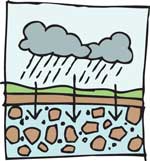
Groundwater supplies are recharged, by rain and snow melt that seeps down into the cracks and crevices beneath the land's surface. In some areas of the world, people face serious water shortages because groundwater is used faster than it is naturally replenished. In other areas groundwater is polluted by human activities.
Make the Summary
Groundwater is the water found underground in the cracks and spaces in soil, sand and rock. It is stored in and moves slowly through geologic formations of soil, sand and rocks called aquifers.
-
Groundwater supplies drinking water for 51% of the total U.S. population and 99% of the rural population.
-
Groundwater helps grow our food. 64% of groundwater is used for irrigation to grow crops.
-
Groundwater is an important component in many industrial processes.
-
Groundwater is a source of recharge for lakes, rivers, and wetlands.
 Aquifers are typically made up of gravel, sand, sandstone, or
fractured rock, like limestone. Water can move through these materials
because they have large connected spaces that make them permeable. The
speed at which groundwater flows depends on the size of the spaces in
the soil or rock and how well the spaces are connected.
Aquifers are typically made up of gravel, sand, sandstone, or
fractured rock, like limestone. Water can move through these materials
because they have large connected spaces that make them permeable. The
speed at which groundwater flows depends on the size of the spaces in
the soil or rock and how well the spaces are connected.Groundwater can be found almost everywhere. The water table may be deep or shallow; and may rise or fall depending on many factors. Heavy rains or melting snow may cause the water table to rise, or heavy pumping of groundwater supplies may cause the water table to fall.
Groundwater supplies are recharged, by rain and snow melt that seeps down into the cracks and crevices beneath the land's surface. In some areas of the world, people face serious water shortages because groundwater is used faster than it is naturally replenished. In other areas groundwater is polluted by human activities.
Make the Summary
Subscribe to:
Posts (Atom)